Blockchain technology has traditionally faced a difficult balancing act. Networks need to maintain security and decentralization while processing transactions quickly enough for real-world applications. As decentralized finance, gaming, payments and other Web3 services expand, transaction speed has become an increasingly important part of blockchain infrastructure.
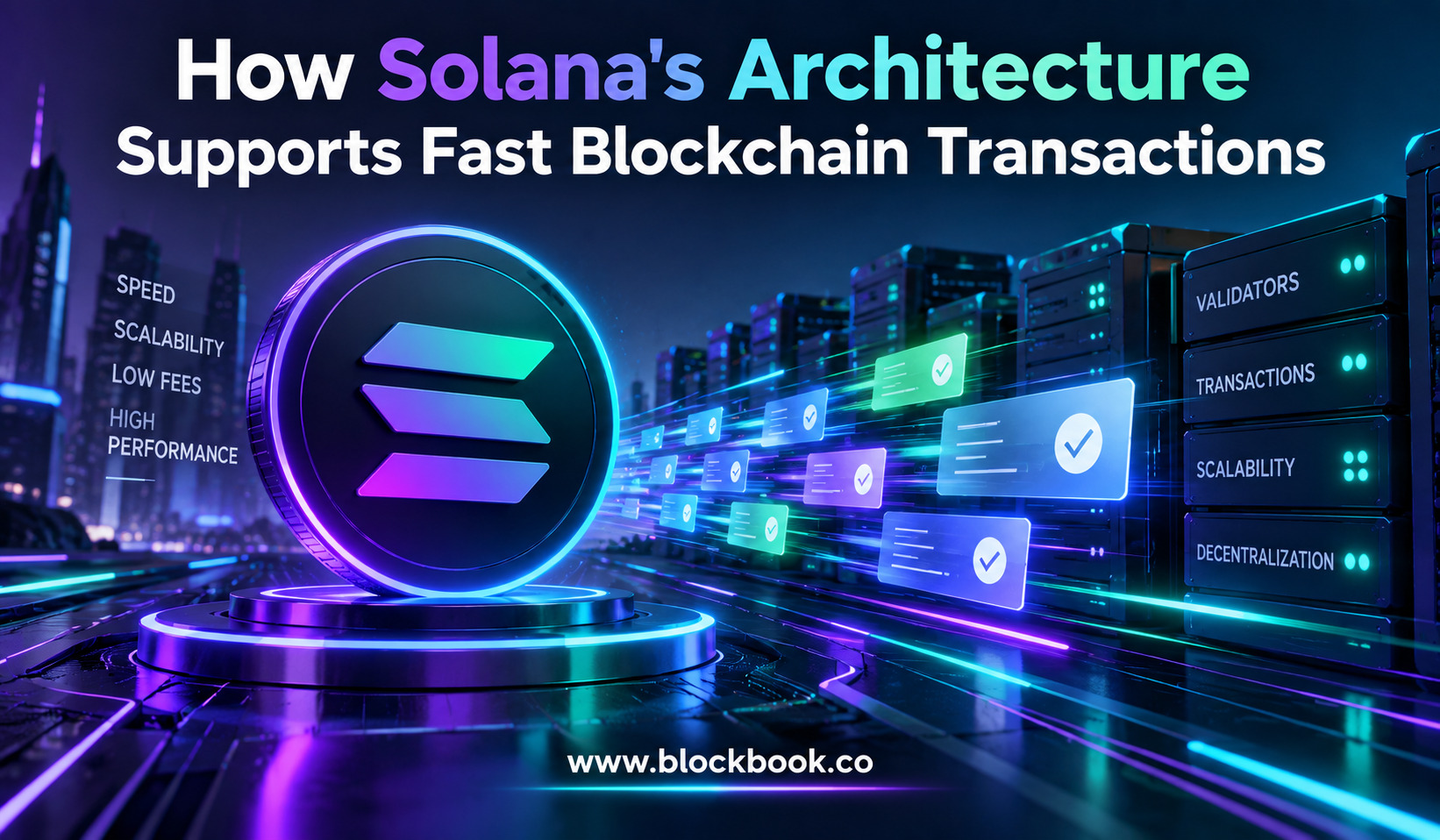
Solana has emerged as one of the blockchain networks designed with performance at the center of its architecture. Instead of relying on a single mechanism to improve transaction processing, Solana combines several technologies and network design principles to increase efficiency. Its architecture includes Proof of History, Proof of Stake, parallel transaction execution and a specialized runtime that allows compatible transactions to be processed simultaneously.
These technologies help explain why Solana is frequently associated with high transaction throughput and low-latency blockchain applications. Understanding how these components work together provides a clearer picture of how the network approaches the challenge of fast blockchain transactions.
Solana Was Designed Around Performance
Many early blockchain networks were designed primarily around establishing decentralized consensus. As adoption increased, developers discovered that processing large numbers of transactions could create bottlenecks. When network demand rises, users may encounter higher fees, longer confirmation times or both.
Solana’s architecture was developed with the objective of supporting substantially higher transaction activity while retaining a decentralized validator network. The network’s design attempts to reduce unnecessary coordination between validators and make better use of modern computing resources.
Rather than treating every transaction as an isolated event that must wait for previous operations to finish, Solana uses a combination of cryptographic timekeeping, optimized data propagation and parallel execution.
This approach allows the network to handle different types of workloads more efficiently, although actual performance can vary depending on network conditions, transaction complexity and validator infrastructure.
Proof of History Creates a Cryptographic Clock
One of Solana’s most recognizable architectural features is Proof of History, commonly abbreviated as PoH.
Proof of History is not a replacement for consensus. Instead, it provides a way for the network to establish the passage of time and the ordering of events before consensus is finalized.
Traditional distributed systems can spend considerable resources determining when events occurred and which events came first. Solana’s PoH mechanism uses a sequence of cryptographic computations that can be independently verified. This gives validators a shared reference for the ordering of events.
The concept is important because blockchain validators operate across a distributed network. If they can establish event ordering more efficiently, less communication may be required for certain parts of transaction processing.
This contributes to Solana’s broader performance strategy. PoH essentially provides a cryptographic timeline that other parts of the network can use when processing blockchain activity.
Proof of Stake Handles Network Consensus
Solana also uses Proof of Stake to secure the network and coordinate validator participation.
Validators are responsible for processing transactions and maintaining the blockchain’s state. Their influence within the network is connected to staked SOL, while the protocol uses a leader schedule to determine which validator is responsible for producing blocks or ledger entries at particular points.
The combination of Proof of Stake and Proof of History creates an important distinction in Solana’s design. PoH helps establish the sequence of events, while Proof of Stake provides the consensus and security framework around those events.
This combination reduces some of the coordination burden that could otherwise slow down a distributed network.
For users, the technical details translate into a practical objective: transactions can move through the network without requiring every validator to independently perform every step in the same sequential order.
Parallel Processing Is Central to Solana’s Design
Another major component of Solana’s architecture is parallel transaction processing.
In a blockchain application, transactions can interact with different pieces of data. For example, one transaction may update a user’s token balance while another interacts with an unrelated account. If these operations do not depend on one another, processing them one after another can waste computing resources.
Solana’s runtime is designed to identify transactions that can execute concurrently.
This is supported by Solana’s Sealevel runtime, which allows smart contracts, known as programs on Solana, to specify the accounts they will read or modify. The network can use this information to identify operations that do not conflict.
The result is an architecture better suited to modern multi-core processors. Instead of assuming that all transactions must be handled sequentially, Solana can take advantage of parallel computing where the transaction dependencies allow it.
Important elements contributing to Solana’s transaction performance include:
- Proof of History for cryptographic event ordering
- Proof of Stake for consensus and network security
- Sealevel for parallel smart-contract execution
- Optimized networking and transaction propagation
These components are interconnected. Improving one part of the transaction pipeline alone would not necessarily produce a high-performance blockchain. Solana’s approach focuses on optimizing several stages of the process.
Sealevel and Efficient Smart Contract Execution
Smart contract execution can become a major source of blockchain bottlenecks. If every application operation needs to wait for the previous operation to complete, overall throughput can be limited.
Sealevel approaches this problem by allowing multiple smart-contract instructions to run at the same time when their account dependencies do not conflict.
The account model is therefore important to Solana’s architecture. Transactions identify the accounts they need to access, allowing the runtime to determine potential conflicts.
Suppose two transactions are interacting with completely separate accounts. There may be no reason for one transaction to wait for the other. The runtime can potentially execute both concurrently.
This model is particularly useful for applications with large numbers of independent users or operations. Decentralized exchanges, games, marketplaces and other applications can generate workloads where parallel execution becomes valuable.
Gulf Stream Helps Manage Incoming Transactions
Transaction processing does not begin when a transaction reaches a block. The network first needs to receive, propagate and organize transactions.
Solana uses a mechanism known as Gulf Stream to help forward transactions toward upcoming leaders before they produce their entries.
In a conventional model, transactions may wait in a large mempool until validators decide which transactions should be included. Solana’s architecture takes a different approach by forwarding transactions toward the validator expected to produce the next part of the ledger.
This reduces the need for a large conventional mempool and helps validators prepare for upcoming transaction processing.
The approach can contribute to lower confirmation latency because transactions are already moving through the network before the next leader begins its scheduled work.
Turbine Breaks Data Into Smaller Pieces
Another challenge in a blockchain network is distributing ledger data efficiently.
Solana uses Turbine, a block-propagation protocol inspired by concepts from large-scale distributed data transmission. Rather than requiring the leader to send the complete data set independently to every validator, the data can be divided into smaller packets.
Validators then participate in distributing those packets across the network.
This approach reduces the communication burden placed directly on the leader and allows information to spread through the validator network more efficiently.
The idea is particularly important when block sizes and transaction volumes increase. Efficient data propagation helps prevent network communication from becoming the primary bottleneck.
A Specialized Runtime Makes Better Use of Hardware
Modern computer processors are built around multiple cores, high-speed memory and specialized networking capabilities. Blockchain software that cannot take advantage of these resources may leave significant computing capacity unused.
Solana’s architecture is designed to use available hardware resources aggressively.
Its validator software can perform several tasks simultaneously, including transaction execution, signature verification, data propagation and other network operations. This hardware-oriented approach is part of the reason Solana’s performance model differs from blockchains designed around more sequential execution.
However, higher hardware requirements also create a trade-off. Running a validator can require substantial computing, memory, storage and networking resources. Developers and infrastructure providers therefore need to consider the hardware requirements associated with maintaining high-performance blockchain infrastructure.
How the Architecture Works Together
The individual technologies become more meaningful when viewed as parts of one transaction pipeline.
A simplified transaction journey might involve a user submitting a transaction, the network forwarding it toward the relevant leader, transaction ordering being supported by Proof of History, execution occurring through the runtime, and resulting ledger data being distributed through the validator network.
| Architectural Component | Primary Role | Contribution to Performance |
| Proof of History | Establishes event ordering | Reduces coordination around time and sequence |
| Proof of Stake | Provides consensus and security | Coordinates validator participation |
| Sealevel | Executes programs | Enables parallel processing |
| Gulf Stream | Forwards transactions | Helps transactions reach upcoming leaders early |
| Turbine | Propagates ledger data | Improves distribution across validators |
No individual component should be viewed as solely responsible for Solana’s speed. The network’s performance comes from how these systems interact.
Why Fast Transactions Matter for Web3
Speed becomes particularly important when blockchain applications require frequent user interactions.
A decentralized exchange may need to process large numbers of trades. A blockchain game can generate transactions involving digital assets. A payment application may need transfers to settle quickly. NFT marketplaces can also experience bursts of activity when new collections or events attract users.
In each case, transaction latency and cost can affect the application’s usability.
Solana’s architecture gives developers an infrastructure option designed for these workloads. Instead of treating blockchain transactions as occasional settlement events, applications can potentially incorporate blockchain interactions more deeply into their user experience.
Web3 applications that can benefit from high transaction performance include:
- Decentralized exchanges and other DeFi platforms
- Blockchain gaming and digital asset marketplaces
- Payment and transfer applications
- Consumer-focused Web3 services
The suitability of the network still depends on the application’s specific requirements, security model and infrastructure design.
The Role of Low Transaction Costs
Transaction speed is only one part of Solana’s performance story. Cost also matters.
If every interaction carries a high transaction fee, developers may be forced to reduce the number of blockchain operations their applications perform. Lower-cost transactions can make more frequent on-chain activity practical.
Solana’s architecture is designed to support a high volume of relatively low-cost transactions. This can be useful for applications where users perform many smaller operations rather than a few high-value transactions.
At the same time, fees are not guaranteed to remain identical under every network condition. Developers should account for changes in demand and application-specific transaction requirements when designing their economic models.
Performance Does Not Eliminate Blockchain Trade-Offs
Solana’s architecture demonstrates that blockchain performance can be improved through specialized engineering, but performance comes with trade-offs.
The network’s reliance on relatively capable validator hardware can influence participation requirements. Network reliability and congestion management also remain important considerations for developers and users.
Security is another independent concern. A fast blockchain does not automatically make every application secure. Smart-contract vulnerabilities, faulty economic models and poorly designed applications can still create risks.
For this reason, developers need to evaluate performance alongside decentralization, security, reliability and ecosystem support.
Solana’s Architecture and the Future of Blockchain Scaling
The development of Solana reflects a broader trend in blockchain engineering. As decentralized applications become more complex, networks need to make better use of modern computing technology.
The industry is increasingly exploring parallel execution, specialized virtual machines, optimized networking and other approaches to scaling blockchain infrastructure.
Solana’s architecture provides one example of how these ideas can be combined into a single network. Its use of Proof of History, parallel execution, transaction forwarding and efficient data propagation demonstrates a design philosophy centered on minimizing unnecessary delays throughout the transaction lifecycle.
Future blockchain development will likely continue experimenting with different approaches. Some networks may prioritize maximum decentralization, others may focus on modular scaling, while performance-oriented networks may continue optimizing hardware and execution.
Conclusion
Solana’s ability to support fast blockchain transactions comes from a combination of architectural choices rather than a single technological breakthrough. Proof of History provides an efficient method for ordering events, Proof of Stake supports consensus, Sealevel enables parallel execution, while systems such as Gulf Stream and Turbine help manage transaction forwarding and data propagation.
Together, these technologies create a blockchain architecture designed to take advantage of modern computing and networking capabilities.
As Web3 applications move toward more frequent and interactive on-chain activity, transaction performance will remain an important consideration for developers. Solana’s architecture offers one approach to addressing that challenge, while its long-term relevance will continue to depend on the network’s ability to balance speed with security, reliability, decentralization and sustainable ecosystem growth.
Frequently Asked Questions
1. What makes Solana transactions fast?
Solana combines several technologies, including Proof of History, Proof of Stake, parallel execution and specialized data-propagation systems. Together, these components reduce processing and communication bottlenecks.
2. What is Proof of History in Solana?
Proof of History is a cryptographic method for establishing the sequence and passage of time between events. It works alongside Proof of Stake rather than replacing the network’s consensus mechanism.
3. What is Sealevel?
Sealevel is Solana’s parallel transaction-processing runtime. It allows compatible smart-contract operations to execute simultaneously when their account dependencies do not conflict.
4. Does Solana process every transaction in parallel?
No. Transactions that depend on the same state or accounts may have execution dependencies. Parallel processing is possible when transactions can safely operate independently.
5. Why is transaction propagation important?
A blockchain must distribute transaction and ledger data among validators. Solana’s networking architecture is designed to move this information efficiently, helping prevent communication delays from becoming a major bottleneck.
About the Author