
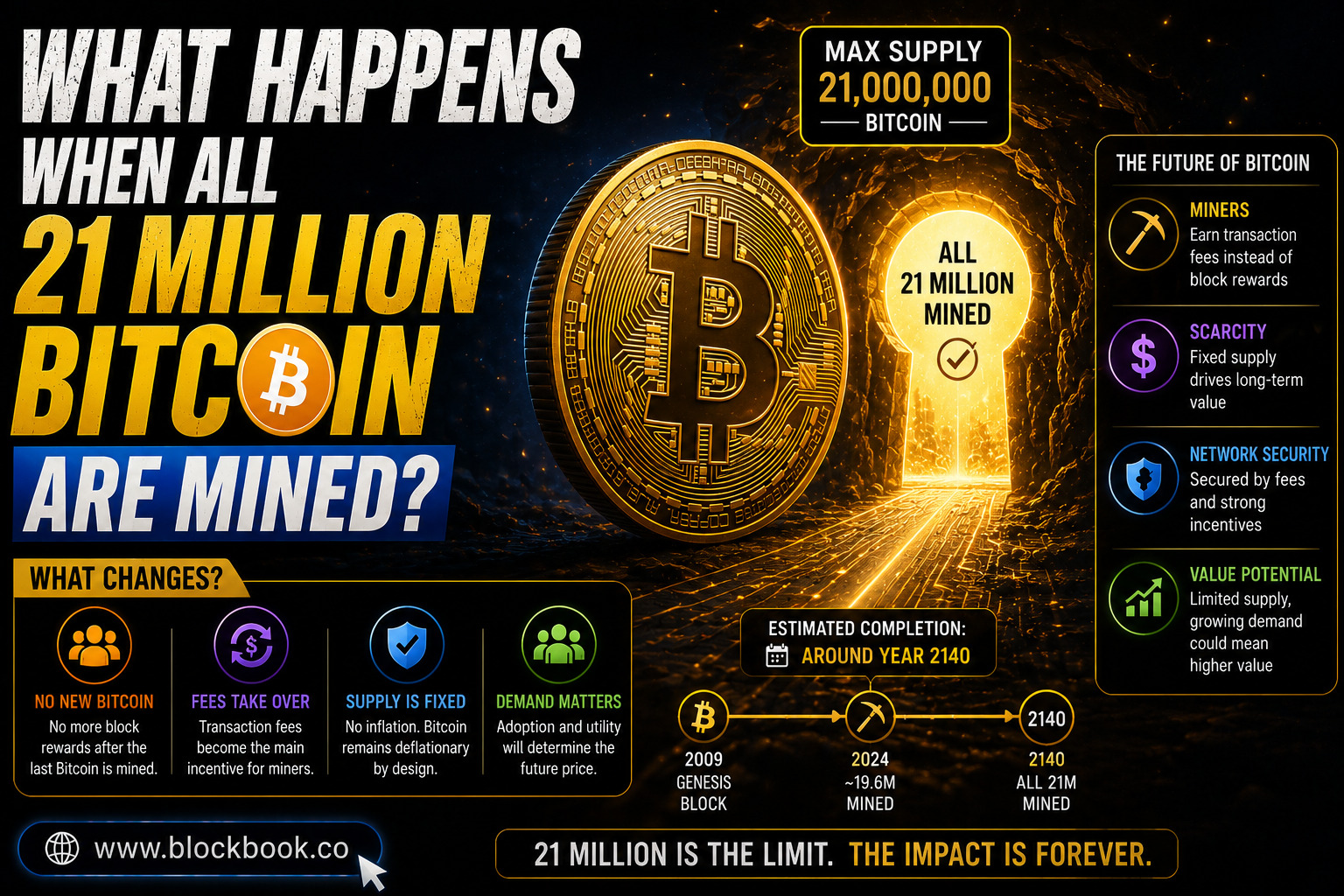
Every ten minutes, a Bitcoin miner somewhere adds a new block to the blockchain and collects a reward for doing it. That reward has already been cut in half five separate times since 2009, and it is scheduled to keep shrinking until it hits zero, permanently, sometime around the year 2140. When the last satoshi is mined, Bitcoin will not stop working. It will just start running on an entirely different economic engine.
That transition is over a century away, which makes it easy to dismiss as science fiction. But the mechanics behind it are already shaping how miners operate today, and understanding the endgame actually explains a lot about decisions the network is making right now.
The Math Behind the 21 Million Cap
Bitcoin’s fixed supply is not a marketing promise, it is written directly into the protocol’s code. When Bitcoin launched in 2009, miners earned 50 BTC for every block they successfully mined. Roughly every four years, or more precisely every 210,000 blocks, that reward cuts in half in an event called the halving.
That schedule has taken the block reward from 50 BTC down to 25, then 12.5, then 6.25, and following the April 2024 halving, down to its current level of 3.125 BTC per block. Each halving does not eliminate new supply, it just slows the rate of new coins entering circulation, approaching zero asymptotically rather than stopping all at once. Because of how that math works, the final fractional satoshi is not expected to be mined until around the year 2140.
Why 2140 Specifically
The math here is genuinely elegant once you see it laid out. Every halving cuts new issuance in half, and this compounding reduction means the total amount of new Bitcoin created each cycle keeps shrinking toward zero without ever technically reaching it in a clean mathematical sense. In practice, though, Bitcoin’s smallest unit, the satoshi, is indivisible, so eventually the block reward rounds down to an amount too small to represent, and issuance effectively stops.
Working through the halving schedule, that point lands around 2140, which is why you will see that year cited consistently across nearly every serious analysis of Bitcoin’s long-term supply curve.
What Actually Changes for Miners
This is the part that generates the most debate, because it touches on Bitcoin’s core security model. Miners currently earn revenue from two sources: the block subsidy, meaning newly created Bitcoin, and transaction fees paid by users sending Bitcoin. Right now, the block subsidy still dominates. Miners collectively mint several hundred BTC worth of new coins daily, while transaction fees typically make up a relatively small share of total miner revenue, often in the single-digit percentage range.
After 2140, that ratio flips completely. The block subsidy drops to zero, and transaction fees become the entirety of miner income. That is a massive structural shift, and it raises a legitimate question that has been debated in Bitcoin circles for years: will transaction fees alone be enough to keep miners motivated to secure the network?
The Security Budget Question
Here is why this matters beyond miner profitability. The total amount miners earn, called Bitcoin’s “security budget,” is what funds the computing power protecting the network from attacks. A lower security budget theoretically means fewer miners find it worthwhile to participate, which could reduce the total computing power securing the blockchain and, in an extreme scenario, make certain attacks more feasible.
There are two broad camps on how this plays out.
The Optimistic Case
Supporters of Bitcoin’s long-term fee model point to a few reasonable arguments. If Bitcoin’s price continues appreciating over the coming century, even modest transaction fees denominated in Bitcoin could translate into substantial dollar-denominated miner revenue. Additionally, if global adoption and transaction demand grow significantly, competition for limited block space could naturally push fees higher, creating a self-sustaining fee market without requiring any protocol changes.
The Skeptical Case
Critics counter that a fee-only model has never been tested at the scale Bitcoin would require by 2140, and there is no guarantee demand for block space will grow enough to compensate for the lost subsidy. Some worry this could lead to network centralization, where mining becomes viable only for the largest, most efficient operators, potentially concentrating too much control in too few hands.
How the Network Might Adapt Before 2140
A few developments already underway could meaningfully influence how this plays out, long before the actual subsidy hits zero.
- Layer 2 scaling solutions, like the Lightning Network, move many transactions off the main blockchain entirely, which could actually reduce base-layer transaction fee revenue even as overall Bitcoin usage grows, since fewer transactions settle directly on-chain
- Rising Bitcoin adoption as a store of value could mean fewer, larger transactions rather than many small ones, potentially supporting higher per-transaction fees even with lower transaction volume
- Technological efficiency improvements in mining hardware continue reducing the operational cost of mining, which lowers the revenue threshold miners actually need to stay profitable
- Protocol-level proposals, though controversial and unlikely to gain consensus easily, occasionally surface suggesting technical adjustments to Bitcoin’s incentive structure, though the community has historically been resistant to changes affecting the fixed supply model
What This Means for Bitcoin Holders Today
If you are holding Bitcoin now, the 2140 milestone is not something requiring any immediate action, given how far in the future it sits. But it is worth understanding conceptually, because it shapes how you think about Bitcoin’s long-term value proposition.
Unlike a company that can issue new shares or a government that can print more currency, Bitcoin’s supply schedule is mathematically fixed and publicly verifiable by anyone running a node. That scarcity is central to the “digital gold” comparison you hear so often, and the transition to a fee-only miner economy is simply the final chapter of that scarcity story playing out.
A Quick Timeline Recap
- 2009: Bitcoin launches with a 50 BTC block reward
- 2012, 2016, 2020, 2024: Successive halvings reduce the reward to 25, 12.5, 6.25, and now 3.125 BTC
- Ongoing: Halvings continue roughly every four years, each cutting new issuance in half
- Around 2140: The final satoshi is mined, block subsidies drop to zero, and miners transition entirely to a transaction-fee-based revenue model
FAQ
When will the last Bitcoin actually be mined?
Based on Bitcoin’s halving schedule, the final satoshi is projected to be mined around the year 2140, more than a century from now.
Will Bitcoin mining stop after all 21 million coins are mined?
No. Miners will continue validating transactions and securing the network, but their income will come entirely from transaction fees rather than newly created Bitcoin.
Is there a risk Bitcoin’s network becomes less secure after 2140?
It is a genuine debate within the Bitcoin community. Some argue rising Bitcoin value and growing transaction demand will sustain adequate miner revenue through fees alone, while others worry a fee-only model could reduce total mining participation and network security if demand does not grow enough to compensate.
Can Bitcoin’s 21 million supply cap ever be changed?
Technically, a protocol change could alter this, but it would require overwhelming consensus across Bitcoin’s global network of miners, developers, and node operators. The fixed supply is considered one of Bitcoin’s most fundamental and closely guarded properties, making such a change extremely unlikely in practice.
About the Author