
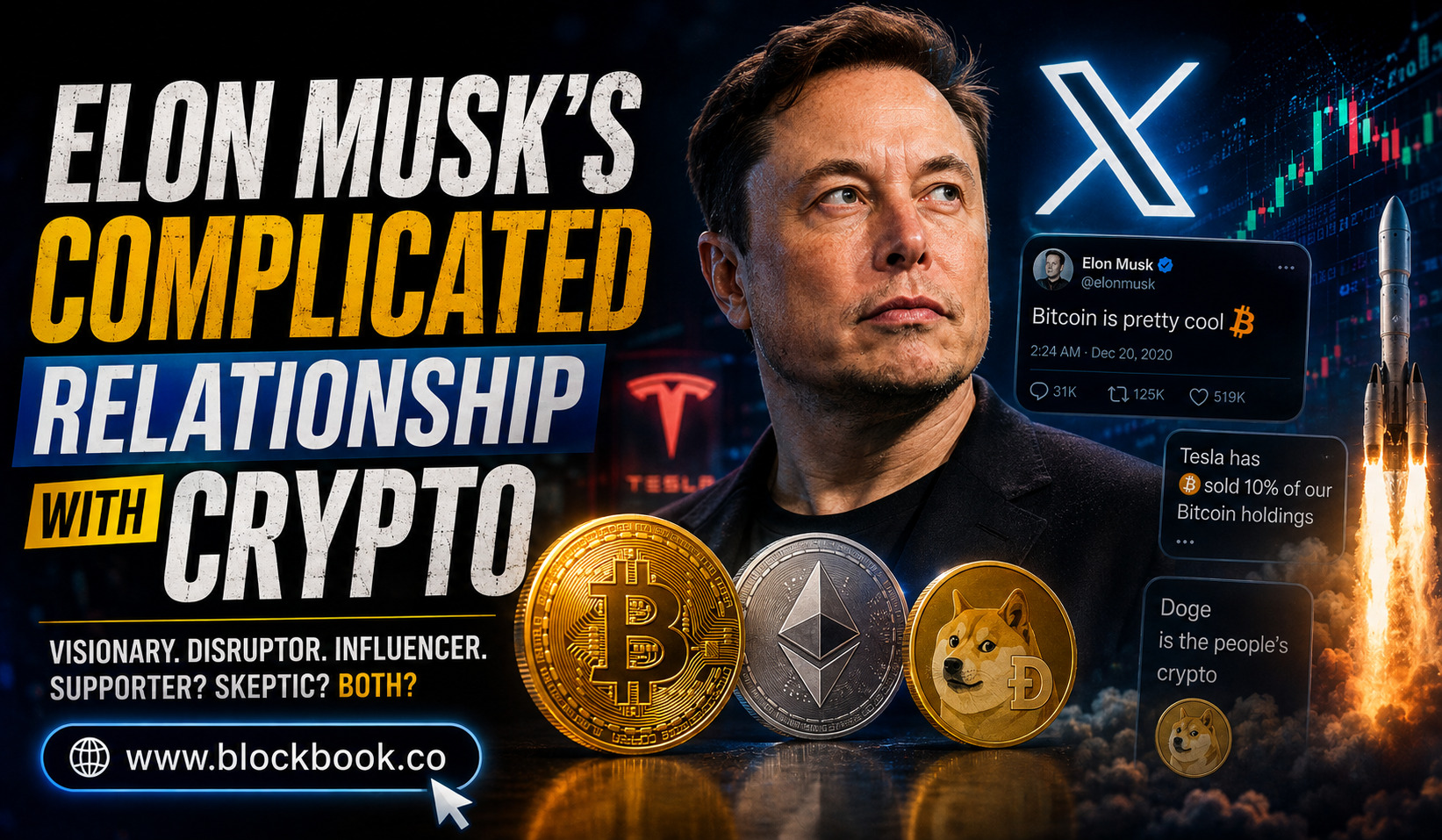
In January 2021, a single tweet from Elon Musk sent Dogecoin’s price up more than 200% in about a day. Five years later, his posts still move the market, but nowhere near as dramatically, and his actual crypto footprint looks a lot narrower than most people assume. Understanding Elon Musk crypto involvement in 2026 means separating what he has actually confirmed from what internet speculation has built around his name.
This is not a simple story of a billionaire pumping his favorite coin. It involves corporate treasury decisions, a lawsuit, a payments platform that deliberately avoids crypto, and a public persona that has arguably become both crypto’s biggest asset and its biggest liability at different points.
What Elon Musk Has Actually Confirmed Owning
Despite years of speculation and dozens of coins claiming a connection to him, Musk’s publicly confirmed personal crypto holdings remain narrow: Bitcoin, Ethereum, and Dogecoin. That is it. Tokens with names like “Eloncoin” or “Musk Token” are third-party creations with no actual link to him.
He first disclosed owning Bitcoin in 2018, saying a friend had sent him 0.25 BTC years earlier. He has never disclosed the current size of that holding. In 2021, during a public conversation often referred to as “The B Word” event, he confirmed personally holding Bitcoin, Ethereum, and Dogecoin, and made a memorable joke describing cryptocurrency as basically an “ASCII hash string.” He has not added new confirmed holdings beyond those three assets since then.
Tesla’s Bitcoin Bet and Retreat
The corporate side of the story is where things get more concrete, and more instructive for anyone trying to separate hype from actual balance sheet decisions.
In early 2021, Tesla purchased $1.5 billion worth of Bitcoin and briefly allowed customers to pay for vehicles using it. That lasted about two months. Tesla suspended Bitcoin payments over environmental concerns tied to mining’s energy use, then sold off the majority of its holdings later that year, citing a need for cash flexibility during pandemic-related uncertainty.
What remains is a much smaller position. Tesla’s reported holdings have hovered in the range of roughly 9,700 to 11,500 BTC in recent filings, worth somewhere around $1 billion depending on the price at the time of reporting. It is a real position, but a fraction of the original bet, and it has not grown meaningfully since the 2021 sell-off.
SpaceX has its own separate Bitcoin exposure, reportedly holding a position that has occasionally moved in large blocks, including a wallet transfer worth roughly $150 million in 2025. Between Tesla and SpaceX, Musk’s companies maintain meaningful institutional-level Bitcoin exposure even though his personal holdings remain undisclosed.
Dogecoin: The One That Never Left
If there is one constant in the Elon Musk crypto story, it is Dogecoin. He has called it his favorite cryptocurrency, and Tesla has maintained the ability to accept it for certain merchandise purchases since 2022, with buyers responsible for covering network fees themselves.
Dogecoin’s connection to Musk runs deeper than casual endorsement. When he briefly led a federal cost-cutting initiative known as the Department of Government Efficiency, the acronym DOGE was widely read as a nod to the coin, and DOGE’s price responded with a rally around the announcement. The coin’s advisory structure even includes Jared Birchall, who runs Musk’s family office, representing Musk’s interests directly.
That said, the relationship has not been free of legal consequences. In 2022, a Dogecoin investor filed a lawsuit seeking $258 billion in damages, alleging that Musk, Tesla, and SpaceX had promoted Dogecoin in a manner resembling a pyramid scheme. Musk’s legal team argued his posts and memes were protected speech rather than market manipulation. A federal court dismissed the case in August 2024.
X Money: Crypto-Adjacent, But Deliberately Not Crypto
One of the more interesting developments in 2026 is X Money, the payments feature built into the X platform. Despite years of speculation that Musk would eventually build crypto trading directly into X, the actual product launched as a fiat-only offering, closer to Venmo with a debit card attached than a crypto wallet.
X Money rolled out wider public access in mid-2026, offering peer-to-peer transfers, bank account linking, a Visa debit card, and a yield offering on balances reported around 6%, built through a partnership with Visa and a licensed financial subsidiary. Despite persistent rumors, no crypto trading functionality shipped with the initial launch.
X’s head of product has said crypto-related tools might eventually appear on the platform through a feature called Smart Cashtags, which would surface market data and link users out to actual exchanges rather than allowing trades directly on X. That is a meaningfully more cautious approach than the crypto-native platform some had expected Musk to build.
A few things stand out about this decision:
- It suggests regulatory caution is shaping product decisions more than Musk’s personal crypto enthusiasm
- It positions X Money to compete with traditional fintech apps and stablecoin products rather than crypto exchanges directly
- The yield feature has reportedly drawn scrutiny given ongoing legislative debate over whether nonbank platforms should offer deposit-like returns
Why His Influence on Prices Has Weakened
There is a genuine, measurable shift happening in how much Musk’s posts actually move crypto markets. In 2021, a single tweet could send Dogecoin up 30% within hours. By 2026, the same kind of comment tends to produce smaller, shorter-lived price bumps.
A few reasons explain the change. The crypto market has grown substantially larger and more diversified since 2021, meaning any single influencer’s posts represent a smaller share of overall trading attention. Institutional participation has also increased, and institutional capital tends to respond to fundamentals and regulatory clarity rather than social media posts. Musk himself has also pulled back from the near-constant crypto commentary that defined his 2021 presence on the platform.
What This Means for Anyone Following Musk-Linked Crypto News
If you are trying to make sense of headlines connecting Musk to some new coin or announcement, a few practical filters help:
- Check whether the connection is officially confirmed by Musk, Tesla, SpaceX, or X, rather than assumed from a name or logo similarity
- Separate corporate treasury decisions, like Tesla’s Bitcoin holdings, from Musk’s personal statements, since they are not the same thing
- Remember that price reactions to his posts have generally gotten smaller and shorter over time, not bigger
- Watch actual product launches, like X Money, rather than speculation about what might eventually get built
FAQ
Does Elon Musk still own Dogecoin?
Yes, based on his own public statements from 2021, which remain his most recent confirmed disclosure. He has not provided an updated figure on how much he currently holds.
Did Tesla sell all of its Bitcoin?
No. Tesla sold the majority of its original $1.5 billion Bitcoin purchase in 2021 but has continued holding a smaller position, reported in recent filings at somewhere around 9,700 to 11,500 BTC.
About the Author