
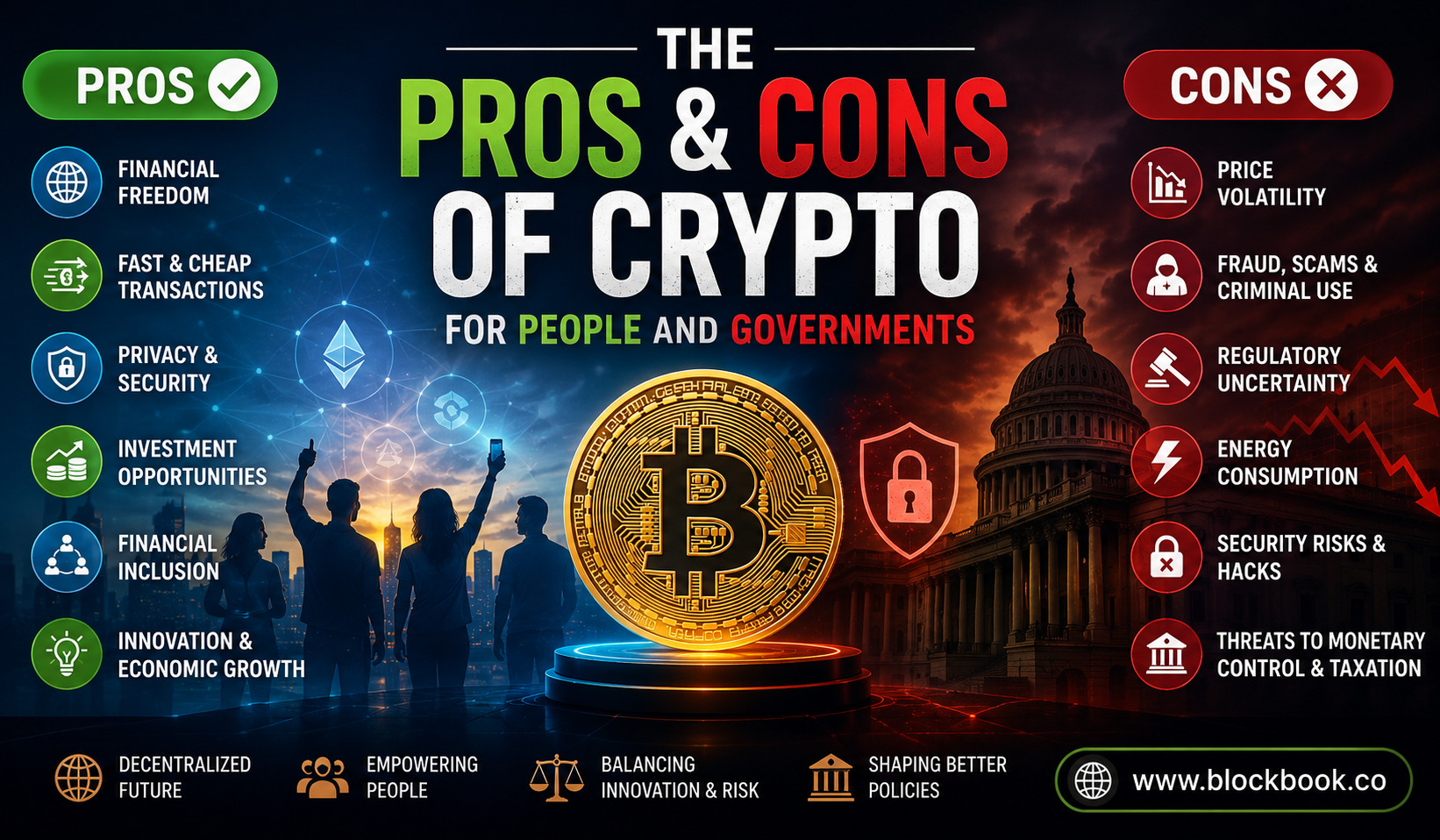
Roughly 560 million people worldwide now own some form of cryptocurrency, according to recent industry estimates, and that number keeps climbing even after years of crashes, scandals, and regulatory crackdowns. That contradiction, massive adoption alongside massive skepticism, is the whole story of crypto in one sentence.
This post lays out the real pros and cons of crypto, both for everyday people deciding whether to get involved and for governments trying to figure out how to handle it.
The case for crypto: benefits for everyday people
An estimated 1.4 billion adults globally still lack access to a traditional bank account. Cryptocurrency only requires an internet connection and a smartphone, no credit history, no minimum deposit, no local branch. For people in countries with unstable banking infrastructure, that access alone can be transformative.
Sending money internationally through a bank can also take several business days and cost a meaningful percentage in fees, especially for smaller amounts. A crypto transaction typically settles in minutes regardless of which two countries are involved, which matters enormously for migrant workers sending money home.
In countries experiencing high inflation or currency controls, some residents have turned to Bitcoin and stablecoins as a way to preserve savings. Argentina and Turkey, both of which have dealt with persistent inflation in recent years, have seen notably higher rates of crypto adoption than more economically stable countries.
And with crypto held in a personal wallet, no bank can freeze the account, no third party can reverse a transaction, and no institution sits between the user and their money. This appeals strongly to people who value financial independence, though it comes with a serious tradeoff covered below.
The case against crypto: drawbacks for everyday people
Bitcoin has lost more than 50 percent of its value from recent highs on multiple occasions, sometimes within a matter of weeks, making it a poor fit for anyone who can’t tolerate sharp swings. There’s also no safety net if something goes wrong: lose your private key or send funds to the wrong address, and there’s no customer service line or FDIC-style insurance to make you whole.
Exposure to fraud is another real problem. The largely unregulated corners of the crypto market have produced some of the biggest financial scams in recent history, from fake projects to collapsed exchanges. And there’s a real learning curve, since wallets, private keys, gas fees, and network confirmations are unfamiliar territory for most people, and mistakes are often irreversible.
Why governments are interested in crypto’s upside
Governments aren’t purely adversarial toward crypto. Several see genuine potential benefits worth capturing.
Countries that create clear, workable rules for crypto businesses stand to attract investment, jobs, and technical talent. Singapore and the United Arab Emirates have both positioned themselves as crypto-friendly hubs specifically to draw this kind of activity away from more restrictive jurisdictions.
Crypto trading also generates real economic activity, and most governments now tax capital gains from it. As adoption grows, so does the potential tax base, provided enforcement mechanisms keep pace with the technology.
The underlying blockchain technology behind crypto has inspired several countries to explore central bank digital currencies as well, essentially government-issued digital cash built on similar technical principles, aimed at making payments faster and more traceable.
Why governments are wary of crypto’s risks
Central banks manage inflation and economic stability partly by controlling the money supply. Widespread use of privately issued digital currency, especially stablecoins, could weaken that control if enough economic activity shifts outside the traditional banking system.
Crypto’s pseudonymous nature has also made it a tool for money laundering, ransomware payments, and sanctions evasion in some documented cases. This remains one of the strongest arguments regulators use for tighter oversight, even as the majority of crypto activity is legitimate.
Collapses like FTX in 2022, which wiped out customer funds for an estimated one million creditors, put real pressure on governments to act. Without adequate protections, ordinary investors bear the full cost when a platform mismanages or misuses their money. And a large enough failure in the crypto market, particularly involving stablecoins tightly connected to traditional finance, could theoretically spill over into broader markets. Regulators increasingly treat this as a real, not hypothetical, concern.
Weighing it all together
For everyday people, crypto tends to make the most sense as a small, deliberate part of a broader financial picture rather than a primary savings vehicle, especially given its volatility. For governments, the challenge is capturing the genuine benefits, financial access, innovation, and payment efficiency, without inheriting the risks that have caused real harm in the past.
Neither side of this debate is going away soon. The technology keeps advancing, adoption keeps growing, and the tension between individual financial freedom and systemic oversight is likely to define how digital currency develops over the next decade.
Frequently asked questions
Is crypto a good investment for beginners?
It can be part of a diversified approach, but only with money someone can afford to lose given how volatile it is. Beginners should understand wallets, security practices, and tax implications before investing any meaningful amount.
Why do some governments ban crypto while others embrace it?
It comes down to differing priorities. Governments worried primarily about capital flight and financial stability tend toward restriction, while those prioritizing innovation and investment tend toward clearer, more permissive regulation.
Does crypto actually help unbanked populations?
In many documented cases, yes, particularly in regions with unstable currencies or limited banking infrastructure, though access still requires a smartphone and reliable internet, which aren’t universal.
What is the biggest risk of holding crypto personally?
For most individual holders, the biggest practical risk is losing access to their own funds through a lost private key, a scam, or sending money to the wrong address, all of which are irreversible.
About the Author