
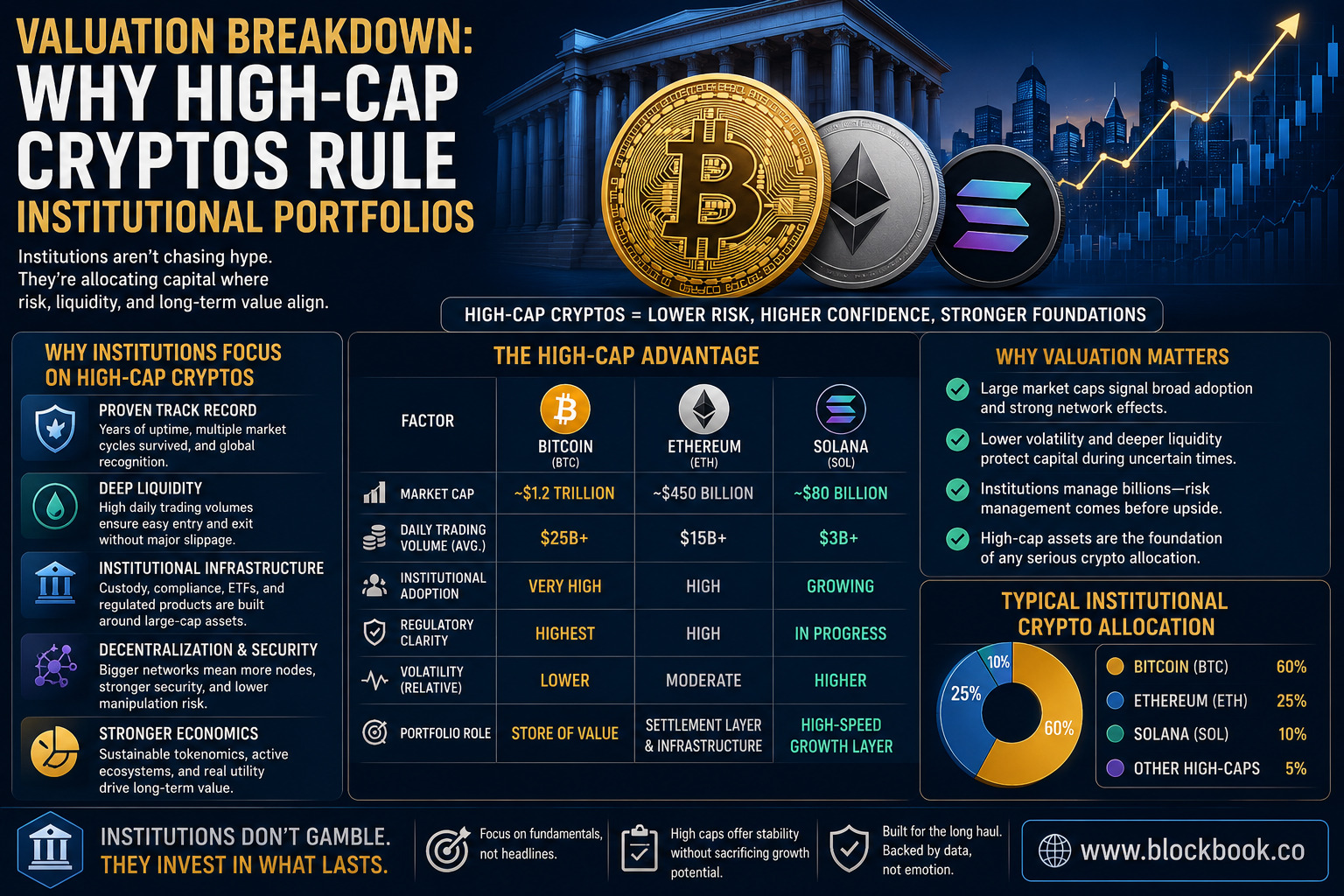
Ask a pension fund manager or a family office how they’re approaching crypto in 2026, and the answer almost never involves a small-cap token nobody has heard of. Bitcoin now shows up in ninety-one percent of institutional crypto portfolios, and Ethereum sits right behind it at ninety percent, while thousands of other coins fight over table scraps.
That concentration isn’t an accident or a lack of imagination. It reflects a specific set of priorities that institutional crypto portfolios are built around, and understanding those priorities explains almost everything about how big money actually allocates to this asset class.
The core-satellite model almost everyone uses
Most institutional frameworks build crypto exposure around what’s called a core-satellite structure. A large, stable core holding anchors the portfolio, while smaller satellite positions add growth potential without threatening the whole thing if one of them goes to zero.
In crypto, that structure almost always looks like heavy Bitcoin exposure at the center. Conservative institutional models run around eighty percent Bitcoin, fifteen percent Ethereum, and five percent altcoins. More aggressive versions might shift to something closer to sixty percent Bitcoin, twenty-five percent Ethereum, and fifteen percent altcoins, but the underlying logic stays the same across the board.
VanEck, one of the more visible asset managers in this space, has publicly recommended a split close to seventy-one percent Bitcoin and twenty-nine percent Ethereum for institutional clients as of mid-2026. That two-asset structure alone accounts for the overwhelming majority of most institutional crypto books.
Who leans hardest into Bitcoin
Not every institution allocates the same way, and the differences track fairly closely with how conservative the mandate is.
Corporate treasuries tend to run the most concentrated, often holding eighty to ninety percent Bitcoin, prioritizing capital preservation and liquidity above all else. Endowments and foundations typically favor seventy to eighty percent Bitcoin, reflecting fiduciary obligations that push toward the most established asset available. Crypto-native funds run comparatively looser, often sitting between fifty and seventy percent Bitcoin, since these managers already have the operational expertise to handle more altcoin exposure. European institutions skew toward seventy-five to eighty percent Bitcoin due to more conservative regulatory environments, while Asian institutions have historically carried somewhat higher altcoin exposure.
The pattern across every category points the same direction, just different degrees. Nobody is building a crypto portfolio with altcoins at the center and Bitcoin as an afterthought.
Why liquidity ends up mattering more than upside
Retail investors often chase the coin with the biggest expected percentage gain. Institutions generally don’t, and the reason comes down to liquidity risk rather than a lack of ambition.
A pension fund or asset manager needs to be able to enter and exit a position in size without moving the market against themselves. Bitcoin’s market cap, well above eight hundred billion dollars for most of 2026, and its deep trading volume across regulated venues make that possible in a way a smaller token simply can’t support. Try moving a nine-figure position through a coin with a few hundred million dollars in market cap, and the trade itself will crater the price before it even finishes executing.
This liquidity requirement is a big part of why institutional OTC crypto trading concentrated so heavily around Bitcoin and Ethereum through the first half of 2026, with institutional investors accounting for a record seventy-two percent of spot over-the-counter volume during that stretch.
Regulated access changed the entry point entirely
Spot Bitcoin ETFs fundamentally reshaped how institutions get exposure, and the data shows just how much that mattered. Cumulative net inflows into US spot Bitcoin ETFs have exceeded fifty-eight billion dollars since their 2024 launch, with total assets under management fluctuating between roughly seventy-seven and ninety-one billion dollars through 2026 depending on market conditions.
Ethereum ETFs trail behind but have shown real staying power too, with assets under management recently sitting around twenty-one billion dollars. No other cryptocurrency currently has anything close to that level of regulated, ETF-wrapped access in the United States, which mechanically limits how much institutional capital can flow toward smaller tokens through the channels these investors actually prefer to use.
The custody shift nobody expected
One of the more telling data points from 2026 institutional surveys involves how priorities around custody have changed. Regulatory compliance as a custody selection criterion jumped from twenty-five percent to sixty-six percent year over year, and security protocols saw a similarly sharp rise to sixty-six percent. Cost, by contrast, collapsed from being cited by forty-nine percent of institutions down to just seven percent.
That shift says a lot. Institutions are no longer shopping for the cheapest way to hold crypto. They’re shopping for the safest and most compliant way, and that filtering process naturally pushes capital toward assets and platforms with the longest track records, which again tends to mean Bitcoin and Ethereum.
Why this concentration makes sense
Think about how a conservative real estate investor builds a property portfolio. They’re far more likely to anchor their holdings in a stable, established market like a major city center than to put the bulk of their capital into an unproven neighborhood that might triple in value or might collapse entirely. The unproven neighborhood isn’t necessarily a bad bet; it’s just not where the bulk of a fiduciary’s money belongs.
High-cap cryptocurrencies function the same way for institutional allocators. Bitcoin and Ethereum aren’t necessarily the assets with the highest expected return over the next year. They’re the assets an institution can defend to its own board, regulators, and clients as a reasonably prudent choice, backed by years of trading history and regulatory clarity that smaller tokens simply haven’t earned yet.
Where the real money sees room to grow
None of this means institutions are ignoring the rest of the market entirely. Interest in tokenized real-world assets has become one of the fastest-growing areas of institutional crypto activity, with sixty-three percent of surveyed institutions describing themselves as very interested in the space, up several points from the prior year.
Notably, the specific appetite has shifted toward safer instruments. Interest in tokenized money market funds and government or corporate bonds grew sharply through 2026, while interest in tokenized equities and commodities actually cooled. Institutions keep gravitating toward the most stable, liquid, and well-understood version of whatever opportunity they’re looking at, whether that’s a base-layer cryptocurrency or a tokenized financial product built on top of one.
FAQ
What percentage of institutional crypto portfolios is Bitcoin?
Bitcoin typically makes up sixty to ninety percent of institutional crypto portfolios depending on the type of institution, with corporate treasuries running the highest concentration and crypto-native funds running comparatively lower.
Why don’t institutions hold more altcoins?
Liquidity is the main constraint. Institutions need to enter and exit large positions without moving the market, and most altcoins lack the trading volume and market depth to support that kind of size, regardless of their growth potential.
How much has flowed into spot Bitcoin ETFs?
Cumulative net inflows into US spot Bitcoin ETFs have exceeded fifty-eight billion dollars since their 2024 launch, with total assets under management ranging between roughly seventy-seven and ninety-one billion dollars through 2026.
Are institutions interested in smaller cryptocurrencies at all?
Some, mainly through tokenized real-world asset products rather than direct altcoin holdings, with growing interest specifically in tokenized money market funds and bonds rather than more speculative token categories.
About the Author