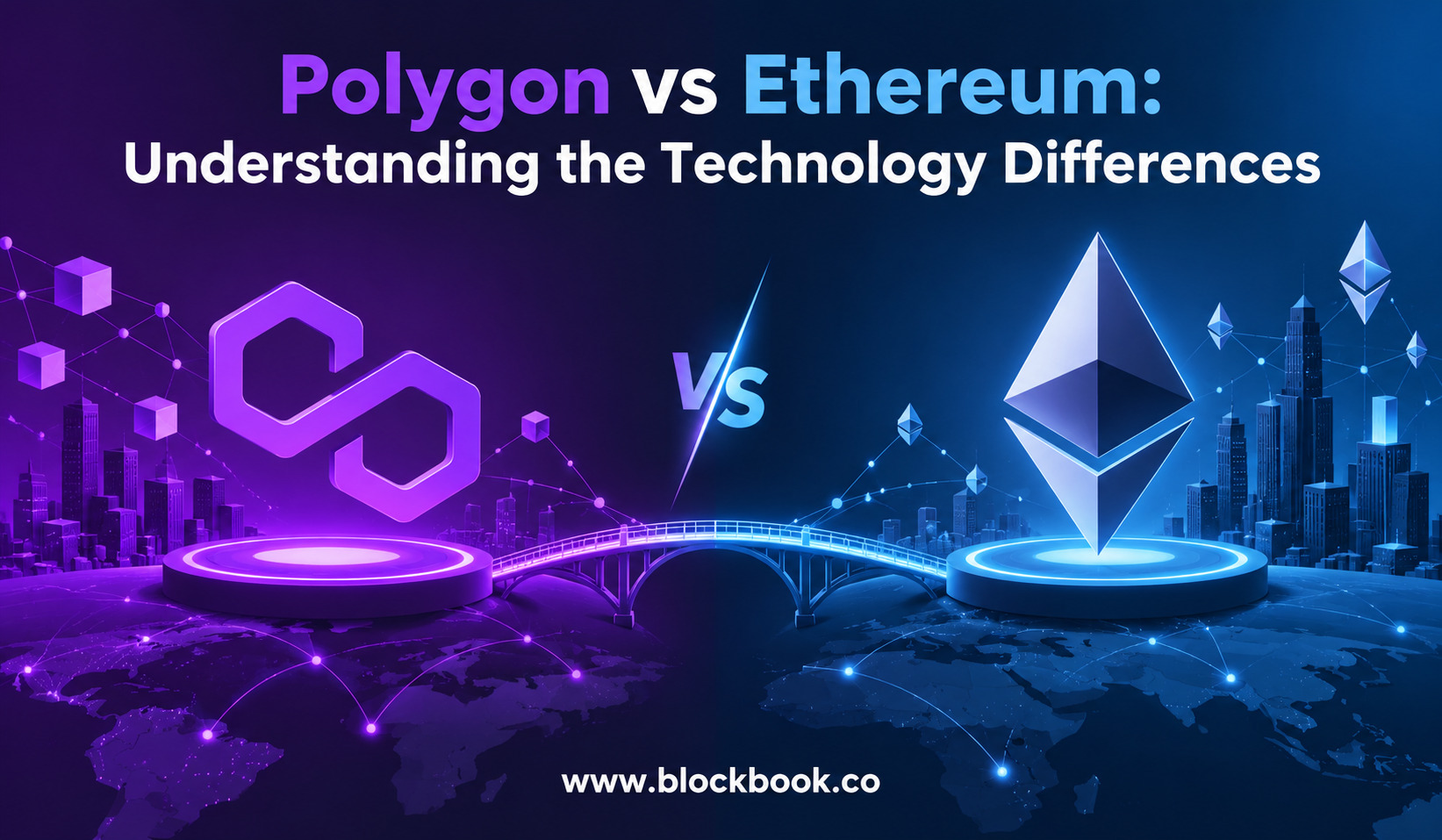
Ethereum and Polygon are two closely connected names in the blockchain industry, but they serve different roles within the broader Web3 ecosystem. Ethereum is a major decentralized blockchain platform used for smart contracts, decentralized applications and digital assets. Polygon, meanwhile, has developed a broader collection of scaling and interoperability technologies designed to support blockchain applications and extend the capabilities of Ethereum and other networks.
The relationship between the two can sometimes create confusion. Polygon is not simply another version of Ethereum, and comparing the two requires looking at their architecture, transaction processing, security models, costs, development environments and long-term technology strategies.
As blockchain applications continue to expand, these differences have become increasingly important for developers and users. Ethereum continues to operate as a foundational blockchain network, while Polygon has increasingly focused on scalable infrastructure and an interconnected multi-chain environment.
Ethereum’s Role in the Blockchain Ecosystem
Ethereum was introduced as a programmable blockchain capable of supporting applications through smart contracts. Unlike a blockchain designed primarily for transferring cryptocurrency, Ethereum provides an environment where developers can create decentralized applications with programmable rules.
Over the years, Ethereum has become a major platform for decentralized finance, NFTs, stablecoins, decentralized applications and tokenized assets. Its large developer community and extensive ecosystem have also contributed to its position within Web3.
Ethereum’s architecture has changed significantly since its launch. In 2022, Ethereum transitioned from proof-of-work to proof-of-stake through The Merge. Today, validators secure the network by staking ETH rather than using energy-intensive mining.
Ethereum’s base layer places a strong emphasis on decentralization and security. However, its limited block space means that transaction demand can affect fees and network capacity. This has contributed to the growth of Layer 2 networks and other scaling systems.
What Is Polygon?
Polygon began with a focus on providing scaling infrastructure connected to Ethereum. Polygon PoS became one of the ecosystem’s best-known networks, providing an Ethereum-compatible environment for decentralized applications and transactions.
The Polygon ecosystem has since expanded beyond a single network. Its technology strategy now includes Polygon PoS, zero-knowledge research, chain-development infrastructure and AggLayer, an interoperability and aggregation system intended to connect different blockchain networks.
This means that the phrase “Polygon” can refer to a broader technology ecosystem rather than one blockchain alone.
For developers, this distinction matters because Polygon’s current strategy is increasingly centered on giving applications different infrastructure options while maintaining connections between networks.
Architecture: Ethereum and Polygon Take Different Approaches
Ethereum operates as a primary blockchain network where transactions and smart-contract execution take place on its base layer. Its Layer 2 ecosystem then provides additional execution environments that settle or interact with Ethereum.
Polygon PoS, in contrast, operates as a separate proof-of-stake blockchain that is Ethereum-compatible. It was designed to provide lower-cost and higher-throughput transaction processing while maintaining connections with Ethereum.
Polygon’s broader technology strategy goes further by exploring zero-knowledge-based systems and aggregation. AggLayer is intended to connect participating chains and support interoperability between different blockchain environments.
This creates an important distinction. Ethereum is the foundational Layer 1 network, while Polygon has developed infrastructure that can operate alongside Ethereum and connect different blockchain systems.
Transaction Costs and Network Activity
Transaction fees are among the most visible differences for users. Ethereum’s fees can fluctuate depending on network demand and available block space. During periods of high activity, users may pay more to have transactions processed.
Polygon PoS was designed to provide a lower-cost environment for blockchain transactions. This can make it useful for applications where users need to interact with smart contracts frequently.
The difference can be particularly relevant for consumer-facing applications. A blockchain game, loyalty program or digital collectible platform may involve many smaller transactions. Developers may therefore consider infrastructure where transaction costs are more manageable.
However, transaction fees should not be considered in isolation. Users and developers also need to consider security, liquidity, interoperability, decentralization and application requirements.
Security Models
Security is another major technological difference.
Ethereum’s proof-of-stake network is secured by validators who stake ETH. The economic security of Ethereum is tied to the value at stake and the participation of its validator ecosystem.
Polygon PoS uses its own proof-of-stake architecture and validator system. While it is connected to Ethereum, its security model is not identical to Ethereum’s base layer.
This distinction is important because an Ethereum-compatible network does not automatically have exactly the same security properties as Ethereum itself. Developers need to understand the architecture and trust assumptions of the network on which their applications operate.
Polygon’s growing focus on zero-knowledge technology introduces another approach to verification. ZK systems can use cryptographic proofs to demonstrate that transactions or computations have been processed correctly.
Ethereum vs Polygon: Technology Comparison
| Technology Area | Ethereum | Polygon |
| Primary role | Layer 1 blockchain | Scaling and interoperability ecosystem |
| Consensus on main network | Proof of stake | Polygon PoS uses proof of stake |
| Smart contracts | Native smart-contract platform | Ethereum-compatible smart-contract environments |
| Transaction costs | Variable with network demand | Generally designed for lower-cost activity on Polygon PoS |
| Scaling approach | Layer 2 ecosystem and protocol upgrades | PoS, ZK technologies, specialized chains and aggregation |
| Native asset | ETH | POL |
| Developer environment | Ethereum ecosystem | Strong Ethereum compatibility |
| Interoperability focus | Broad ecosystem support | AggLayer-focused multi-chain connectivity |
Smart Contracts and Developer Experience
Both Ethereum and Polygon are attractive to developers because of Ethereum’s established smart-contract ecosystem.
Ethereum developers commonly work with Solidity and tools designed around the Ethereum Virtual Machine. Polygon PoS supports Ethereum-compatible smart contracts, allowing developers to adapt many existing applications and development practices.
This compatibility has helped Polygon attract developers who already understand Ethereum. Instead of moving to an entirely different programming environment, teams can work within a familiar framework.
The difference comes primarily in the infrastructure surrounding execution. Developers choosing Ethereum directly may prioritize its base-layer security and established ecosystem. Teams using Polygon infrastructure may prioritize transaction efficiency, application requirements and access to Polygon’s scaling ecosystem.
Scaling: A Major Point of Difference
Ethereum’s scaling strategy increasingly relies on a combination of protocol improvements and Layer 2 networks. Rather than processing every transaction directly on the mainnet, Layer 2 systems can execute transactions separately and periodically provide data or proofs to Ethereum.
Polygon has explored several approaches to scaling. Polygon PoS provides an Ethereum-compatible network, while Polygon has invested heavily in zero-knowledge technology.
Polygon previously operated Polygon zkEVM Mainnet Beta, an Ethereum-compatible ZK rollup. However, that network was officially sunset on July 3, 2026, with its sequencer stopping block production.
This development highlights an important point about blockchain infrastructure: technology strategies change over time. Polygon’s current direction increasingly emphasizes aggregation and interoperability through AggLayer rather than relying exclusively on the earlier zkEVM deployment.
AggLayer and Ethereum’s Multi-Chain Environment
AggLayer is one of the most important parts of Polygon’s newer strategy. Polygon describes it as an aggregation layer designed to connect different blockchain networks and support interoperability.
The concept addresses a challenge created by blockchain scaling itself. If many networks are created to increase capacity, applications and liquidity can become fragmented.
Polygon’s approach attempts to allow different chains to remain specialized while communicating with one another through common infrastructure.
This differs from Ethereum’s role as a foundational blockchain. Ethereum provides the underlying Layer 1 environment, while Polygon is increasingly building infrastructure intended to connect multiple networks.
The two approaches can therefore complement one another rather than simply compete.
Native Tokens: ETH and POL
Ethereum’s native asset is ETH. It is used to pay transaction fees and plays a central role in Ethereum’s proof-of-stake security through validator staking.
Polygon’s native ecosystem token is POL. Polygon transitioned from MATIC to POL, with POL becoming the native gas token on Polygon PoS in September 2024.
Polygon has described POL as having broader utility within its developing ecosystem, including staking and other network services.
For users and developers, this means that the native token used for transaction fees can differ depending on the network being used.
Where Developers May Use Each Network
The choice between Ethereum and Polygon depends heavily on the application’s requirements. Developers building applications that require direct interaction with Ethereum’s base layer may choose Ethereum. Others may prefer Polygon infrastructure for applications involving frequent transactions and cost-sensitive user interactions.
Common application categories include:
- Decentralized finance and trading.
- Gaming and digital assets.
- Payments and stablecoins.
- NFTs, memberships and loyalty programs.
In practice, applications can also use multiple networks. A project might use Ethereum for certain functions while using Polygon infrastructure for higher-frequency activity.
Interoperability and the Future of Web3
The growing number of blockchain networks has made interoperability increasingly important. Ethereum has a large ecosystem of Layer 2 networks and connected applications, while Polygon is developing technology specifically focused on aggregation and cross-chain connectivity.
This suggests that the future may not be a simple choice between Ethereum and Polygon. Web3 applications could increasingly use several networks depending on their requirements.
Polygon’s AggLayer strategy reflects this possibility. Instead of requiring every application to operate on one chain, developers could potentially build specialized networks that remain connected to a broader ecosystem.
Challenges to Consider
Both ecosystems face technical challenges. Ethereum needs to continue improving scalability while maintaining security and decentralization. Its Layer 2 ecosystem also creates questions around interoperability, user experience and liquidity fragmentation.
Polygon faces its own challenges as it develops a broader multi-chain infrastructure. Cross-chain communication and aggregation require strong security assumptions, reliable infrastructure and continued developer adoption.
The retirement of Polygon zkEVM Mainnet Beta also demonstrates that developers must monitor changes in blockchain infrastructure. Projects built for the long term need to evaluate current network roadmaps and documentation rather than relying solely on historical information.
Conclusion
Ethereum and Polygon occupy different but increasingly connected positions in the blockchain ecosystem. Ethereum provides a major Layer 1 foundation secured through proof of stake, while Polygon has developed infrastructure focused on scaling, efficient transactions and interoperability.
Polygon PoS offers an Ethereum-compatible environment for applications that need frequent blockchain activity, while Polygon’s newer strategy increasingly focuses on zero-knowledge technology, specialized chains and AggLayer.
For developers and users, the technology differences are therefore more nuanced than a simple comparison of speed or transaction fees. Ethereum emphasizes base-layer security and decentralization, while Polygon provides additional infrastructure designed to expand blockchain capacity and connect different networks.
Frequently Asked Questions
Is Polygon the same as Ethereum?
No. Ethereum is a Layer 1 blockchain, while Polygon is a broader ecosystem of scaling and interoperability technologies. Polygon PoS is a separate Ethereum-compatible proof-of-stake network.
Is Polygon faster than Ethereum?
Polygon PoS is designed to process transactions with higher throughput and lower costs than direct Ethereum mainnet activity. Actual performance depends on network conditions and the specific application.
Which token does Polygon use?
Polygon uses POL as its native ecosystem token. POL became the native gas token on Polygon PoS in September 2024.
Does Polygon depend on Ethereum?
Polygon has strong technological and ecosystem connections with Ethereum, but individual Polygon networks have their own architectures and security models.
About the Author