
A single Bitcoin costs more than most cars on the road today, yet it’s not even close to the priciest thing you can buy on a crypto exchange. Once you rank coins purely by price per coin, a handful of names most casual investors have never heard of start showing up right alongside Bitcoin and Ethereum.
This list breaks down the most expensive cryptocurrencies trading right now, based on price per coin as of late July 2026, and explains what actually pushes a token’s price that high.
Price per coin is not the same as market cap
Before getting into the ranking, it helps to clear up a common mix-up. A coin’s price and a coin’s total value are two very different numbers, and confusing them leads to bad conclusions.
Market cap is the price multiplied by the total number of coins in circulation. It tells you the total value the market has assigned to a project. Price per coin, on the other hand, is just what one unit costs, and it says almost nothing on its own about how big or important a project actually is.
A coin with a tiny supply of 40,000 tokens can trade at thousands of dollars each while having a market cap smaller than a mid-size local business. Meanwhile a coin like XRP trades for close to a dollar but has a market cap in the tens of billions because billions of tokens exist. Neither number is “more correct.” They just measure different things.
The most expensive coins ranked by price
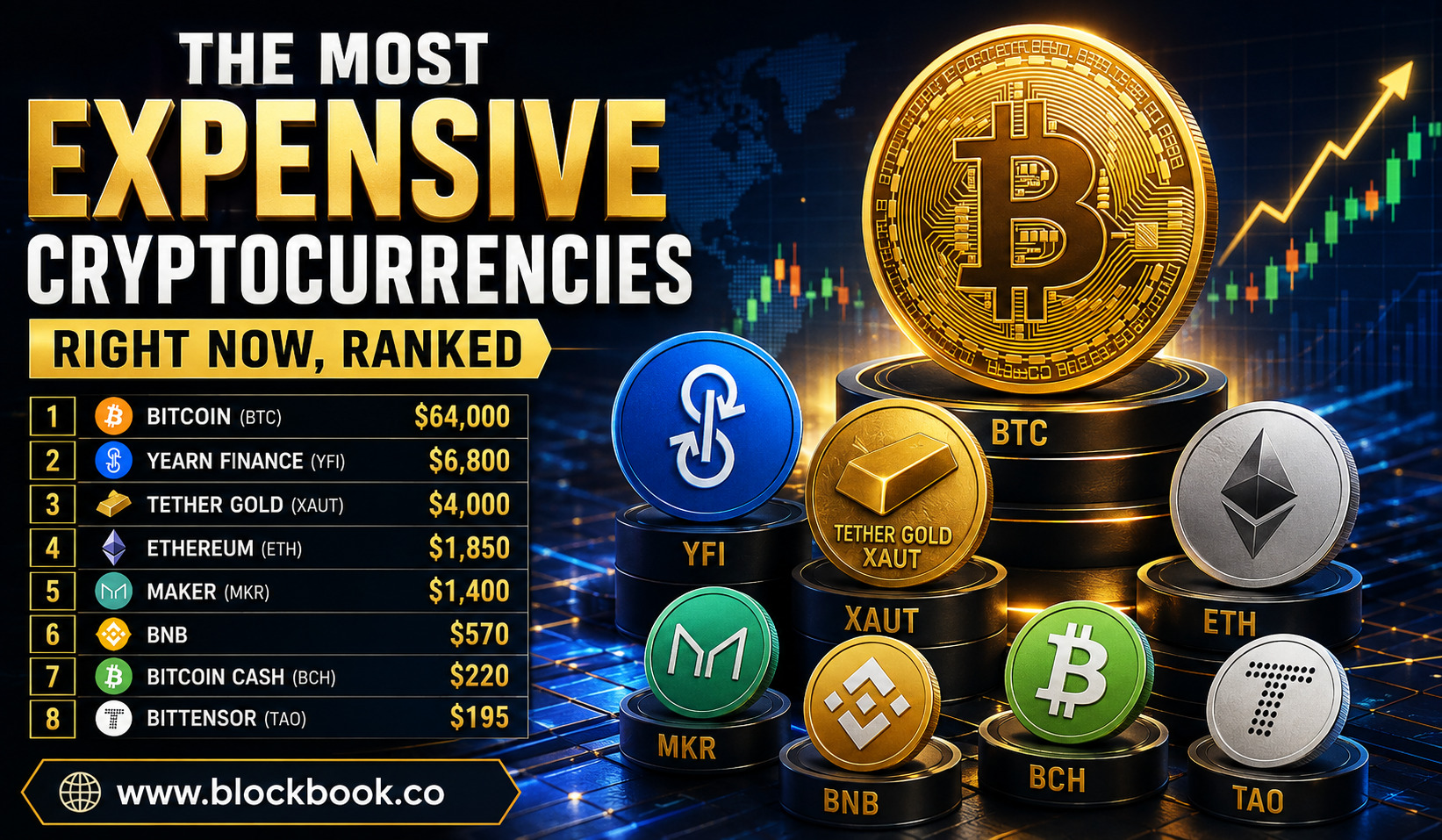
Here’s how the top of the list looks right now, ranked strictly by dollar price per coin.
Bitcoin (BTC), trading around $64,000
Yearn Finance (YFI), trading around $6,800
Tether Gold (XAUT), trading around $4,000
Ethereum (ETH), trading around $1,850
Maker (MKR), trading around $1,400
BNB, trading around $570
Bitcoin Cash (BCH), trading around $220
Bittensor (TAO), trading around $195
Prices swing constantly, so treat these as a snapshot rather than a fixed number. Still, the order rarely shuffles much month to month because the underlying supply dynamics behind each coin don’t change quickly.
Why Bitcoin still sits alone at the top
Bitcoin’s price towers over everything else on this list by a wide margin, and the gap isn’t close. Roughly 19.7 million of its 21 million maximum coins have already been mined, leaving less than five percent of total supply still to be released.
That scarcity, combined with over a decade of institutional trust building and now direct exposure through spot Bitcoin ETFs, keeps demand strong even during the kind of price pullback the market saw through the first half of 2026. Scarcity paired with Bitcoin’s head start on adoption is the single biggest reason nothing else has closed the gap.
The surprising runner-up: Yearn Finance
Most people assume Ethereum holds the number two spot, but Yearn Finance actually outprices it per coin. YFI is a governance token for a decentralized finance protocol that helps users find yield-earning opportunities across different platforms without manually comparing dozens of interfaces.
The reason its price sits so high has almost nothing to do with fame and almost everything to do with supply. Only about 36,700 YFI tokens will ever exist, an intentionally tiny number set at launch. When a token’s total supply is smaller than the population of a single small town, even modest demand can push the price into the thousands.
If an artist releases 36,000 prints of a piece worldwide, individual prints will command a higher price than a poster that got printed by the millions, even if the mass-produced poster is more culturally recognized. Supply scarcity does a lot of the heavy lifting on price, independent of overall popularity.
Gold-backed tokens: a different kind of expensive
Tether Gold takes the third spot, and it works differently from every other coin on this list. Each XAUT token is backed by a specific amount of physical gold held in a vault, so its price tracks the gold market almost exactly rather than moving on crypto-specific news or sentiment.
This makes XAUT a useful case study in how price per coin can be an arbitrary design choice rather than something the market discovered. Tether could have structured XAUT to represent one gram of gold instead of a full troy ounce, and the price per token would look completely different while representing the exact same underlying value. The number of coins issued is often a deliberate decision, not a natural law.
Ethereum and the governance token cluster
Ethereum rounds out the top four, and it’s worth pausing on why it trades well below Bitcoin despite being the second-largest cryptocurrency by market cap. Ethereum has over 120 million coins in circulation, roughly six times Bitcoin’s circulating supply, so the same total market value gets divided across far more units.
Maker sits just behind Ethereum on this list for a similar reason to Yearn Finance. It’s a governance token tied to the MakerDAO protocol, which underpins the DAI stablecoin, and its supply is capped at a modest 90,000 tokens. Holders use MKR to vote on which assets can back DAI and how the protocol’s risk parameters get set.
BNB, by contrast, blends both worlds. It has a moderate supply of around 135 million tokens, but Binance has been running a quarterly token burn program for years that steadily shrinks that number, which has helped support the price even as the token remains widely used to pay trading fees on the exchange.
What actually drives a coin’s price that high
Three factors keep showing up across this list.
Small total supply. Coins like YFI and MKR were designed from day one with limited issuance, which mechanically inflates price per unit regardless of the project’s overall size.
Deflationary mechanics. BNB’s burn program and Ethereum’s fee-burning system since its 2022 shift to proof of stake both remove coins from circulation over time, tightening supply further.
Trust built over time. Bitcoin’s price reflects sixteen years of surviving crashes, hacks, regulatory threats, and skepticism without the network itself ever failing. That track record isn’t something a new project can shortcut.
None of these factors are about which project is “better” in some abstract sense. A high price per coin says more about a token’s supply design than about its long-term usefulness or adoption.
Does a high price mean a good investment?
Not by itself, and this is where a lot of newer investors get tripped up. A coin trading at $6,000 is not automatically a stronger holding than one trading at six cents. What matters is the ratio between price, supply, adoption, and the actual demand for whatever the token does.
Bittensor is a useful example here. TAO trades under $200, well below several other names on this list, yet it has one of the fastest-growing use cases in crypto right now as the fuel token for a decentralized AI network. Its lower price per coin simply reflects that more of its total supply has room left to enter circulation, not that the project is somehow less serious than Yearn Finance or Maker.
FAQ
What is currently the most expensive cryptocurrency?
Bitcoin remains the most expensive cryptocurrency by price per coin, trading around $64,000 as of late July 2026, well ahead of the next closest coin.
Why is Yearn Finance more expensive than Ethereum?
Yearn Finance has a fixed supply of only about 36,700 tokens, compared to Ethereum’s circulating supply of over 120 million coins, which pushes its price per token much higher despite Ethereum having a far larger total market value.
Is a higher price per coin a sign of a better investment?
Not necessarily. Price per coin mainly reflects how few units exist, not the quality or adoption level of the underlying project. Market cap and real-world usage are generally better indicators of a project’s overall standing.
Do these rankings change often?
The order shifts occasionally with market conditions, but it tends to stay fairly stable month to month since the supply mechanics behind each coin, like fixed caps and burn programs, change slowly by design.
About the Author