Ethereum still processes more than half of all decentralized finance value on the planet, yet Solana has closed a gap this year that almost nobody predicted two years ago. Both networks now claim the same prize: becoming the default settlement layer institutions trust to move real money on-chain.
This isn’t a speed contest anymore, even though speed still matters. It’s a fight over which architecture Wall Street decides to build its plumbing on, and the two chains are winning in genuinely different ways.
Two very different bets on what institutions want
Ethereum vs Solana stopped being a simple story of old guard versus new challenger a while ago. Ethereum bet that institutions would prioritize security, decentralization, and a long track record over raw throughput. Solana bet that speed and near-zero fees would eventually outweigh those concerns once the network proved it could stay online.
Both bets have paid off, just in different arenas. Ethereum dominates the kind of high-value, slow-moving capital that pension funds and asset managers are comfortable parking for years. Solana has captured the faster-moving world of trading, consumer apps, and payment rails where transaction cost is the deciding factor.
The core technical split
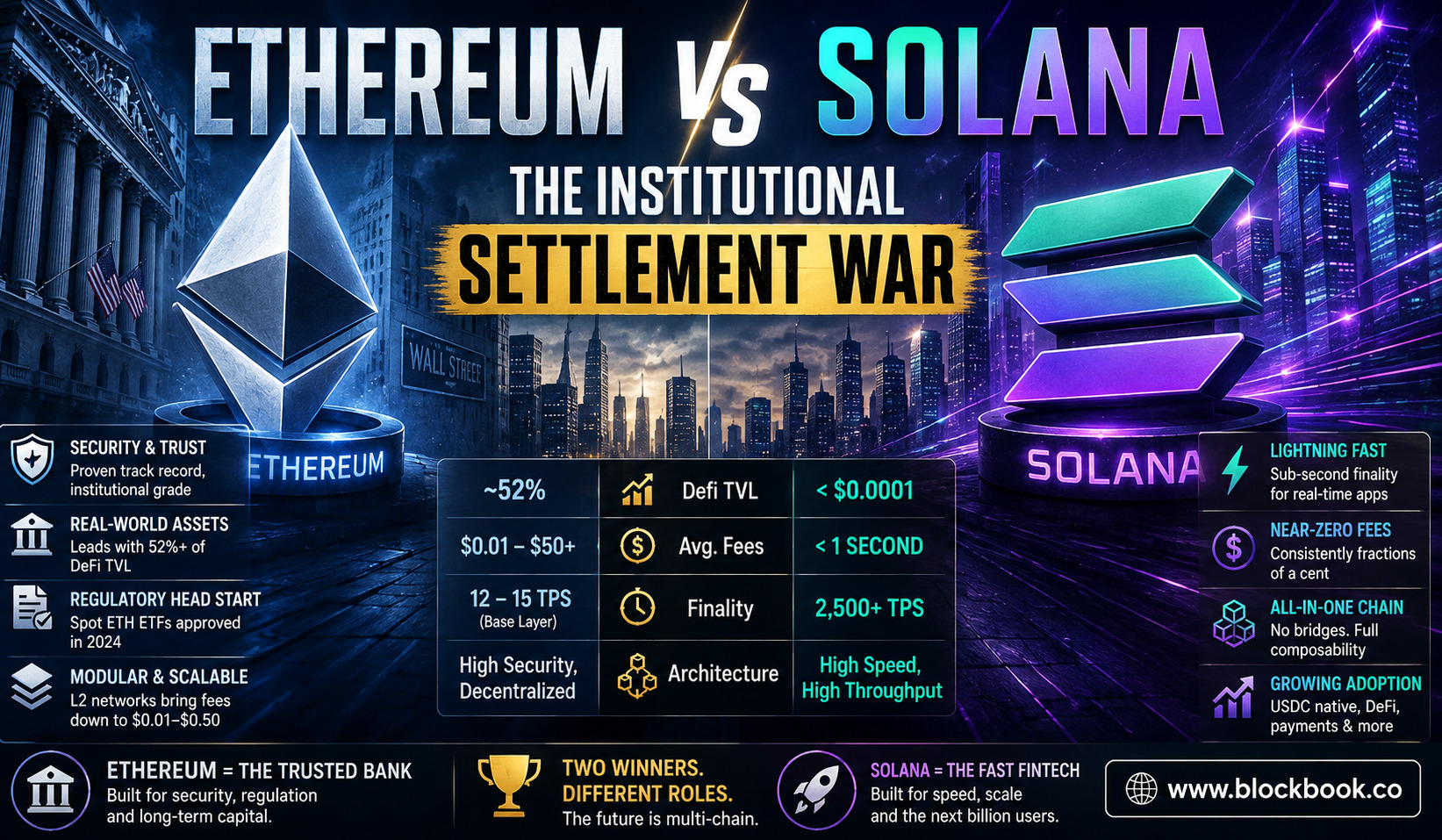
Ethereum runs a modular, rollup-centric design, meaning most everyday activity now happens on Layer 2 networks like Arbitrum, Base, and Optimism that settle back to Ethereum’s base layer for security. Fees on those L2s typically run somewhere between one cent and fifty cents, a massive improvement over the one to fifty dollar fees still common on Ethereum’s main chain during busy periods.
Solana takes the opposite approach, running everything on a single high-speed chain rather than splitting activity across layers. Transaction fees stay consistently below a tenth of a cent, and the upcoming Firedancer validator client is designed to push throughput even higher while adding redundancy against the kind of network outages that hurt Solana’s reputation in past years.
Where Ethereum is winning: tokenized real-world assets
Institutional adoption on Ethereum has concentrated heavily around real-world asset tokenization, and the numbers back that up. Ethereum currently holds roughly 52 percent of global DeFi total value locked, putting it well ahead of every competitor combined.
Major financial institutions have built specifically on Ethereum’s infrastructure for tokenized products. BlackRock’s BUIDL fund and Franklin Templeton’s BENJI fund, both tokenized money market products, chose Ethereum-based rails rather than a newer chain, largely because of its longer security track record and deeper institutional custody support.
That decision matters more than it might seem. When a fund manager is moving hundreds of millions of dollars into a tokenized product, they’re choosing infrastructure they expect to still be trusted a decade from now, not just the cheapest or fastest option available today.
Regulatory head start
Ethereum also has a real first-mover advantage on the regulatory side. Spot Ethereum ETFs received SEC approval back in 2024, giving institutions a regulated way to gain exposure without dealing with direct custody themselves.
Solana spot ETFs, by comparison, remain pending. Multiple firms filed applications, and the political environment around crypto regulation has shifted in a more favorable direction, but approval timing is still uncertain. Markets have already priced in a chunk of that expected approval, so even a green light might produce a smaller price reaction than bulls are hoping for.
Where Solana is winning: speed, cost, and consumer reach
Solana’s pitch to institutions isn’t about being the safest choice. It’s about being the most practical choice for anything that needs to happen fast and cheap at scale.
Solana transactions typically finalize in well under a second, compared to Ethereum’s heavier but more deliberate finality process. Costs stay fractions of a cent regardless of network activity, while Ethereum’s base layer fees can spike sharply during congestion. Every application on Solana operates in the same environment too, so complex DeFi strategies can interact instantly without the added risk of moving assets across separate chains. And reliability has caught up: Solana has maintained continuous uptime for over a year as of early 2026, a meaningful turnaround after outage problems that once scared off institutional interest.
Circle’s decision to issue USDC natively on Solana, not just as a bridged asset, reflects growing confidence that the network can handle serious stablecoin-based treasury operations. High-frequency trading firms and payment companies have taken notice, and that segment of institutional activity increasingly favors Solana’s cost structure over Ethereum’s.
Reading the market cap gap
Ethereum’s market cap still dwarfs Solana’s by a wide margin, and most analysts expect that gap to persist through the rest of 2026 even as it narrows. A reasonable base case puts Ethereum somewhere between $475 billion and $550 billion by December 2026, with Solana landing between $120 billion and $160 billion over the same stretch.
That gap doesn’t mean Solana is losing the broader argument. It reflects two networks being valued on different metrics for different reasons. Ethereum’s deflationary tokenomics, where base transaction fees get burned rather than recycled, have supported its valuation as a long-term capital asset. Solana’s valuation leans more heavily on usage growth and the expectation that real fee revenue will keep climbing as adoption spreads.
The analogy that actually fits
Think of Ethereum as the established bank that has spent decades building trust with regulators and large institutions, slow to change but nearly impossible to dislodge once it has your business. Solana looks more like a fast-growing fintech challenger that wins customers by being cheaper and faster, even though it has to keep proving its reliability every single day to earn the same level of trust the incumbent already has.
Neither comparison is a knock. Banks and fintechs both survive by serving different customer needs, and that’s closer to where Ethereum and Solana actually sit today than a simple winner-take-all framing suggests.
So which one is actually winning?
Honestly, neither has won outright, and the more useful question is which one wins which specific job. Ethereum remains the clear choice for high-value institutional settlement, regulated tokenized funds, and anything where security and a proven track record matter more than speed. Solana remains the clear choice for high-frequency trading infrastructure, consumer-facing applications, and payment use cases where transaction cost is the deciding factor.
Most serious analysts covering this space now recommend holding exposure to both rather than picking a side, often citing a rough split weighted more heavily toward Ethereum given its deeper institutional moat, with Solana making up a smaller but meaningful allocation for growth exposure. The practical reality of the institutional settlement race in 2026 is that it has two separate winners’ circles, not one.
FAQ
Which is bigger, Ethereum or Solana?
Ethereum is significantly bigger by market cap, with a current valuation in the hundreds of billions of dollars compared to Solana’s smaller but fast-growing market cap, and that gap is expected to persist through the rest of 2026.
Does Solana have a spot ETF like Ethereum?
Not yet as of late July 2026. Spot Ethereum ETFs were approved by the SEC in 2024, while Solana ETF applications remain pending, though the regulatory environment has grown more favorable to eventual approval.
Why do institutions prefer Ethereum for tokenized assets?
Ethereum’s longer security track record, deeper custody infrastructure, and existing regulatory clarity have made it the default choice for major tokenized fund products from firms like BlackRock and Franklin Templeton, even though Solana offers lower fees.
Is Solana still prone to network outages?
Solana’s reliability has improved substantially. The network maintained continuous uptime for over a year as of early 2026, following technical upgrades that addressed the causes of its earlier outage problems.
About the Author